

Chen Magal: Healing the Soul Through the Art of Kintsugi


Who hasn’t felt their heart sink when a precious object slips from their hands and shatters? The Japanese art of Kintsugi breathes new life into what once seemed lost forever. In Israel, Chen Magal is keeping this centuries-old craft alive, sharing her expertise with a diverse audience. Chen is a fighter. For more than 11 years, she ran Café Bruxelles in Haifa, but the Covid-19 crisis and successive wars forced her to close its doors in October 2023.
Struggling with a profound sense of emptiness after suddenly finding herself without work, Chen began searching for a new path. Kintsugi, which she had explored as a hobby during her evenings, soon felt like an obvious choice. Her passion became her profession, helping her overcome the void that had taken hold of her. For the past six years, Chen has devoted herself to repairing, restoring and giving a second life to objects that once seemed beyond saving. Her story is one of resilience, reinvention and healing.
Chen has never been to Japan, but, by chance, Japan came to her.
“I think most of the Western world admires Japanese culture because it is so diametrically opposed to our own… and so wonderful. One evening, I watched a film in which they talked about Kintsugi, and I decided to seriously look into it. A friend put me in touch with a man who taught me the basics of the art, and then I continued to develop my skills on my own,” Chen Magal tells Itonnews.

Almost entirely self-taught, Chen did not stop there. She translated articles, published videos about Kintsugi, then created her own website and gradually built a name for herself. Things quickly gathered momentum: commissions, courses and workshops followed, giving Chen a renewed sense of purpose and excitement.
Dating back to the late 15th century, Kintsugi is the Japanese art of “golden repair.” Rooted in the philosophy of Wabi-Sabi, it embodies resilience and rebirth while celebrating the beauty of imperfection. The technique uses a lacquer known as urushi to reassemble broken pieces and highlight their cracks with gold. Scars and the marks left by time are thus transformed into something beautiful — and become part of the object’s story.

The Origins of Kintsugi
After breaking his favorite bowl, the shogun Ashikaga Yoshimasa decided to send it back to China to have it repaired. However, when the object returned crudely mended, the shogun was furious. He then asked his craftsmen to find a more aesthetically pleasing way to restore his beloved bowl.
“In Israel, we don’t yet have the same culture of repairing and restoring objects as they do in Europe, for example. Since October 7, however, the practice has been gaining momentum because it is an art that also heals the soul — and our wounded society desperately needs that. Kintsugi has both a personal dimension and a philosophical value,” says Chen Magal.
An Art Steeped in Universal Values
For Israelis, who are often accustomed to seeking immediate results, this concept can sometimes run counter to their habits. Kintsugi is the exact opposite: it involves numerous stages and waiting periods, requiring patience and humility. Sometimes, the process can take months or even a year. The object undergoes a transformation that mirrors that of the person restoring it.
“Kintsugi brings me serenity. It is an art that provides a certain peace of mind and a deep sense of satisfaction,” Chen explains.

A Unique Ancient Technique
The object is first carefully cleaned, and the fragments are reassembled using urushi, a traditional Japanese lacquer. Cracks and missing sections are then filled, while several layers of lacquer are applied to strengthen and smooth the surface. Between each stage, the object is placed for approximately one week in a furo, a cabinet designed to control humidity and temperature. Once the repair has dried, the cracks are highlighted with gold, silver or other metallic powders.
Objects carry their own stories, and with them, traces of the journeys we each take through life. Most of the pieces Chen works on also hold deep sentimental value for their owners.
“I love vintage Israeli objects, especially those with a unique character. Not long ago, a client entrusted me with his Japanese sake carafe, which had shattered into a thousand pieces. From the very beginning, I felt a strong connection with it, and that connection grew over time. It brought out the very best in me,” Chen recalls.

Courses and Workshops: Individual Therapy in a Group Setting
Haifa, Tel Aviv, and soon Tivon in northern Israel. To pass on her knowledge, Chen organizes five-session courses during which participants work on an object they restore and can eventually take home. Guided by Chen, they learn the fundamental principles and techniques of Kintsugi.
“These two and a half hours of completely disconnecting from reality are an extraordinary experience, something they may only encounter once in their lives. For many, it is even a gateway into a world they want to explore more deeply; some even become addicted to it,” Chen reveals.
“The idea of taking an object that was broken to begin with and making it even more beautiful and unique is fascinating. Japan is teaching us something profound through this art. Japanese culture has such powerful concepts about the passage of time and appreciating every moment, and I believe Israeli society could learn a great deal from it,” says Stéphanie, a participant in the Tel Aviv course.

Several participants come to Chen out of necessity, seeing Kintsugi as a form of therapy capable of helping them heal their wounds. Chen also organizes one-off workshops across the country. The groups are diverse: survivors of the Nova festival, people displaced from the north and south, those directly affected by the October 7 massacre, as well as wounded and trauma survivors.
“By embracing Kintsugi, they give birth to a new version of themselves. It gives them hope because they are repairing themselves through the restoration of an object, highlighting their own scars alongside the cracks in the material. They are then better able to accept their inner fractures, which have become part of their story,” Chen explains.
The Japanese art, which is gaining increasing popularity in Israel, is not without its challenges. At times, Chen faces a significant shortage of replacement pieces, forcing her to be creative in order to achieve the desired final result.
“A few years ago, a woman who worked with ceramics and was suffering from terminal cancer brought me one of her creations that she wanted me to repair before she died. Unfortunately, she passed away a week before I could return it to her. It was very difficult for me because I had so wanted to show her the finished piece. But it is a perfect example of how Kintsugi is subject to the test of time: you simply cannot rush it,” Chen says with sadness.
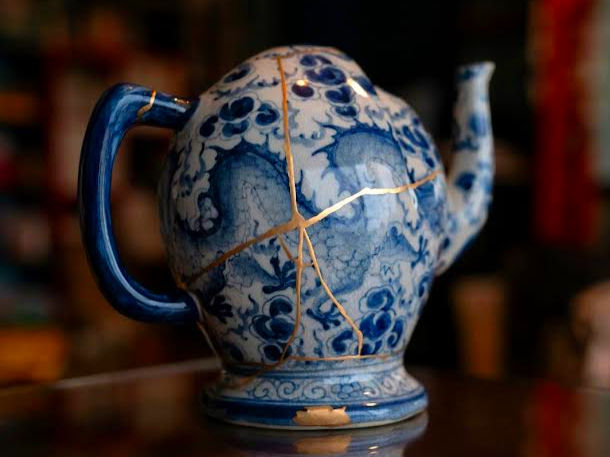
Chen also sells her creations to designers and private clients who commission bespoke pieces. She is not afraid to look beyond Israel for opportunities, and her work has already traveled as far as Japan and Burgundy, France.
“We have to seek out what makes us better. Dreams don’t come true on their own — we are the ones who make them happen,” Chen concludes.
Next April, the artist will finally travel to Japan, fulfilling a lifelong dream and reaching the culmination of a journey that began six years ago.
Chen Magal's website : https://www.kintsugi-israel.com/
Instagram : https://www.instagram.com/ikigai_kintsugicm
Caroline Haïat


Comments