

Breathing Life into the Inanimate: Portrait of Sculptor Shira Zelwer
- Caroline Haïat

- Jan 4
- 5 min read
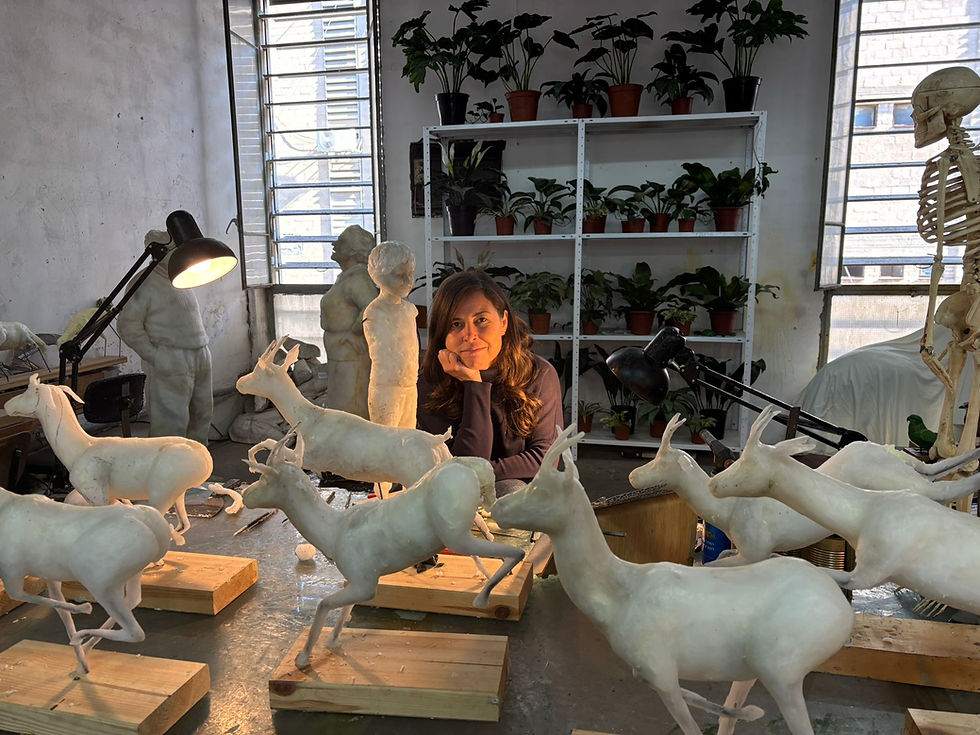
If you walk through Tel Aviv, and more specifically along Ben Gurion Boulevard, you can't miss the sculptures of Israel’s former Prime Minister David Ben-Gurion and his wife Paula—remarkable works that have become landmarks of this central neighborhood. We met the artist who brought them to life with striking precision: the renowned Shira Zelwer. She welcomed us into her studio, located in Kiryat HaMelacha in the south of the city, where sculptures of all kinds immediately set the tone. Shira’s universe is multifaceted, yet it is primarily rooted in the human figure. She openly embraces a desire not to strictly adhere to reality, while drawing inspiration from everyday life. An inspiring personality, her work deliberately blurs the boundaries between art, sculpture, and craftsmanship. In recent years, she has established herself as a singular voice on the Israeli creative scene through a demanding and rigorous engagement with materials, which become a true sculptural language.
Her works have been exhibited in several places across Israel, attracting significant interest from both the general public and professionals in the art and design worlds. Through her practice, Shira Zelwer advocates for an engaged vision of creation: an art grounded in materiality, time, and transmission—one that dialogues with history while speaking resolutely to the present. Her work questions our relationship to objects, as well as issues of identity, memory, and the place of femininity within historical narratives.
“I grew up in Jerusalem, but very early on I felt that my path lay elsewhere. I wasn’t raised in an artistic environment; I was interested in many things without having any specific knowledge in this field. I studied at the Midrasha at Beit Berl in the 2000s, one of the best art schools in Israel. I was fortunate to explore different disciplines there. At first, I didn’t have a clear artistic identity, and then I realized that sculpture was what spoke to me the most—it answered a need I had to create,” Shira told Itonnews.

Giving Art a Human Dimension
Through sculpture, Shira quickly became aware that she could shape forms endowed with a human presence, capturing moments of life, vulnerability, and the fragile nature of existence.
“Sculpture has a very particular quality: it is physically present. It is a mass that shares the same space as we do. There is something extremely powerful in the relationship that forms between a sculpture and the person standing before it. It was this direct, almost bodily connection that drew me to sculpture,” the artist explains.
To infuse matter with humanity, Shira works primarily with wax, a material that evokes flesh. It is slightly translucent, reacts to temperature, and feels almost alive. Unlike concrete, which is heavy and solid, or clay, which is tied to the earth, wax is inherently unstable.

“Wax also has a very strong poetic dimension. When we think of something made of wax, we immediately think of its ability to melt, to disappear. There is this notion of temporality—exactly like the human species. We too are fragile and perishable matter,” Shira says.
373 Bird Sculptures in a Sensational Exhibition
Among the artist’s major projects is the exhibition Gathering of Birds, presented in 2022–2023 at the Tel Aviv Museum of Art, for which Shira hand-crafted 373 birds representing 86 different species. This majestic project was born after she won the Schiff Prize, awarded by the Tel Aviv Museum of Art for figurative art.
“Birds had fascinated me for a long time. I always create from what surrounds me. Israel is one of the world’s major bird migration crossroads. I consulted lists of all the species observed in Israel and chose them entirely intuitively. I work from my feelings and curiosity,” Shira explains.

For an entire year, from five in the morning until ten at night, Shira meticulously sculpted pigeons, sparrows, parakeets, mynas, as well as cranes, pelicans, vultures, and flamingos. She first sculpted all the heads, then created molds to reproduce them. The bodies were built on metal structures, covered with foam and then wax. The feathers were sculpted, molded, cast, assembled one by one, and finally painted with acrylics.
“I wanted to create an impossible gathering—birds from different environments and eras, some migratory, some sedentary, others endangered. An ensemble that could not exist in reality. And ultimately, it became a mirror of the world we live in: a society made up of people from diverse backgrounds, coexisting both harmoniously and with difficulty. Birds embody freedom, movement, the ability to rise above. They surround us, yet we rarely pay attention to them,” the artist reflects.
From the imaginary world of birds to life-size sculptures, Shira Zelwer continues her exploration of the human condition.
David and Paula Ben-Gurion, Like Everyone Else
In a completely different register, Shira Zelwer created the sculptures of David Ben-Gurion and his wife Paula to mark the 50th anniversary of the former Prime Minister’s death. The project originated from a commission by the Municipality of Tel Aviv and marked the first time Shira worked at human scale. Ben-Gurion is depicted with his hands in his pockets, slightly withdrawn, almost lost in thought. Paula, by contrast, adopts a more assertive posture, rendered in more vivid colors.

The sculptures were inspired by a photograph taken in Sde Boker by a Canadian photographer.
“I wanted to represent them as an ordinary couple, in a moment of calm and intimacy. Ben-Gurion is more subdued, more silent, while Paula is more dominant. Even when dealing with a historical figure, what interests me remains the human aspect—I wanted to break the myth of the icon. I chose to portray him at an older age; I didn’t want a heroic, young Ben-Gurion frozen in an official pose. On the contrary, I show him in a much more relaxed, almost nonchalant way, as if he had just stepped out of his home to walk along the boulevard and feed the pigeons,” Shira explains.
Shira often works from a deeply intimate feeling, sometimes linked to nostalgia or a personal memory that later becomes collective. When she created the greenhouse—the hamama—with wax plants, an installation that visitors physically enter, she needed to understand how to make something feel alive, almost breathing before our eyes. The greenhouse is an enclosed, protective space, yet also extremely vulnerable; everything within it can quickly fall out of balance.

Each sculpture is almost an enigma to be solved. Shira has also created a plant exhibited at the Israel Museum—gezer kifach (wild carrot), commonly found along roadsides in Israel.
A sculpted Tel Aviv building, as well as a work based on a photograph of her grandmother when she was working in a catering service in Australia, exhibited at the Museum of Islamic arts at Jerusalem—Shira’s body of work is vast and addresses a wide range of themes.

For her new project, she is working on the Israeli deer, an animal that carries deep meaning in Israeli and Jewish culture.
“It’s not the spectacular reindeer of Santa Claus. It’s a modest, local animal,” she says.
At the same time, Shira is preparing a solo exhibition scheduled to take place in the coming months. In a perpetual quest for identity, she seeks to reveal the beauty of the ordinary and the power of simplicity.
Caroline Haïat


Comments