

In Israel’s Negev, 1,500-Year-Old Grapes Could Help Shape the Future of Wine


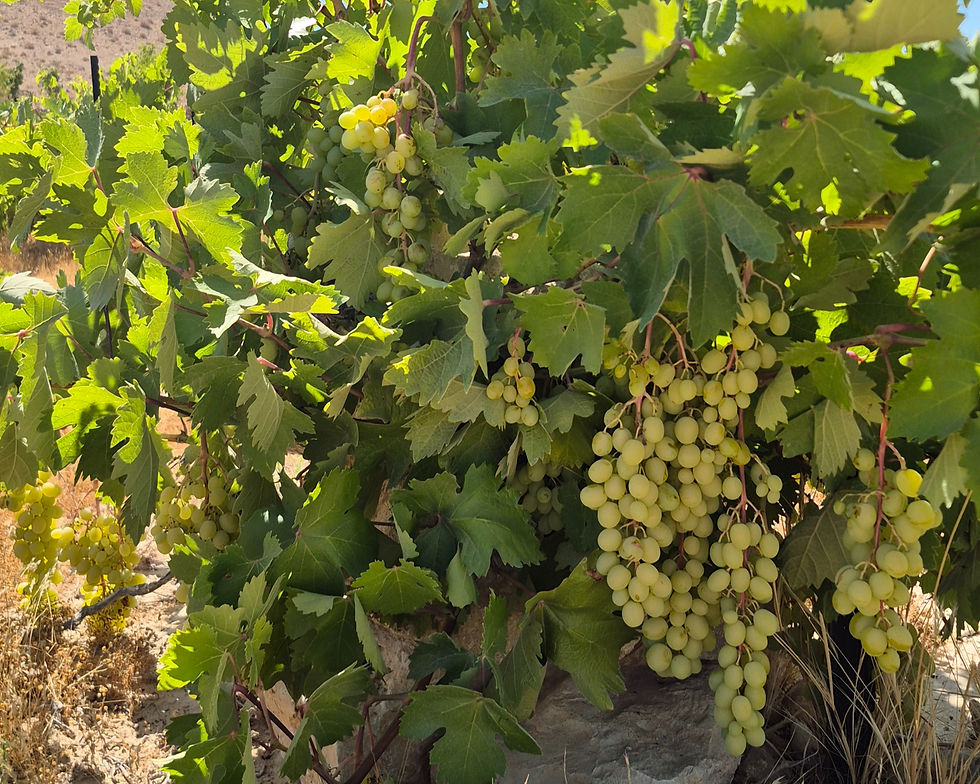
At Avdat, in the highlands of Israel’s Negev Desert, researchers have achieved what once seemed almost impossible: growing grape varieties cultivated in the region nearly 1,500 years ago.
After recovering their DNA from ancient seeds, researchers replanted their descendants and produced a wine whose first tastings surprised wine professionals. But behind the archaeological experiment lies a much broader ambition: identifying grape varieties capable of withstanding rising temperatures, drought and increasingly extreme weather conditions.
The researchers hope to begin selling bottles to the public at Avdat as early as next year, before expanding commercialization over the following three to four years.
An extraordinary archaeological discovery
During excavations carried out between 2017 and 2019, archaeologists discovered charred grape seeds dating back to the seventh century.
Two ancient varieties were identified: Syriki, a dark grape used for red wine, and Ba’ar, which was traditionally used to produce white wine.
One of the researchers had been studying the quantities of grape seeds found in different archaeological layers in an attempt to trace the rise and decline of the Negev’s wine industry during the Byzantine period.
The remains of this agricultural activity are still visible across the region, from ancient agricultural terraces to open areas containing numerous wine presses. Viticulture was once a central part of the economic and archaeological landscape of the Negev.
“The seeds were sent to the University of Haifa. Researchers found that they were sufficiently well preserved to attempt to extract their DNA,” archaeologist Lior Schwimer of the Israel Nature and Parks Authority told Itonnews.
“Further research allowed us to characterize these grapes and identify them as heritage varieties from the southern Land of Israel. After a long process, we managed to find their direct descendants. One of them corresponds to a grape variety that is also found today in Greece.”
Once the varieties had been identified, researchers took cuttings and replanted them without fertilizers, close to where the original seeds had been discovered. The vines were planted near a cave, only a few meters from the remains of an ancient agricultural site dating to the Byzantine period.
The team also sought to reproduce some of the agricultural techniques used at the time, based on the layout of the ancient farming plots.
“At the same time, I carried out excavations at the site with a colleague from the Israel Antiquities Authority, and we discovered a large wine press capable of producing around 6,000 liters a day,” Schwimer said.
The small team soon made another surprising discovery: the ancient cuttings appeared to develop significantly faster than European grape varieties.
“We harvested around 400 kilograms of grapes from the two main varieties and entrusted them to two producers who work using natural methods. They added neither sulfur nor acids. The grapes were left with their skins so that natural yeasts could trigger spontaneous fermentation,” Schwimer explained.

A surprising response from wine professionals
When the first bottles were opened, the reaction was unexpected: the wine was excellent.
Slightly different from modern varieties, more fruit-forward and relatively high in alcohol, it impressed those who had the opportunity to taste it.
“Since then, we have regularly opened a bottle to observe how it evolves. The wine continues to change even after bottling,” Schwimer said.
Journalists, winemakers and wine professionals visiting the site have repeatedly been invited to taste the wine. Syriki was also sent to sommeliers in Tel Aviv, whose reactions were overwhelmingly positive.
The red Syriki has characteristics reminiscent of varieties such as Carignan, Grenache or Syrah. It is fruity and smooth, with pronounced red-fruit notes and relatively high alcohol content.
“We managed to reconstruct part of the winemaking process from the Byzantine period by reproducing several cultivation methods and producing a wine that is excellent,” Schwimer said.
The project is now attracting interest well beyond the archaeological community.
Ancient grapes in a warming climate
The researchers believe the ancient varieties could eventually contribute to the development of a more climate-resilient form of viticulture.
During the Byzantine period, wine production was a major economic activity in the Negev. By the sixth century, an estimated 100,000 agricultural terraces were being cultivated across the region.
The desert receives less than 100 millimeters of rainfall per year, yet thousands of dunams of vineyards, dozens of wine presses and large-scale production facilities once operated there. Some estimates suggest that the region may have produced as much as one million liters of wine annually.
Producing wine on such a scale in the desert required highly sophisticated agricultural systems, including channels for collecting and distributing water and infrastructure designed to capture and make use of virtually every drop of rainfall.
Today, those ancient techniques are being examined from a different perspective.
Beyond its historical and archaeological significance, Schwimer’s research could have implications for the wine industry as climate change increases temperatures and water scarcity in many traditional wine-producing regions.
According to Schwimer, the ancient grape varieties demonstrate that it is possible to cultivate vines under conditions of extreme heat and limited water availability.
The research is not based solely on archaeological evidence. It also draws on agricultural knowledge passed down through local communities, including the Bedouin communities of the Negev.
“Bedouins in the region told me how they used to protect the vines from birds,” Schwimer said. “They would sit next to the plot with a rope attached to two pieces of metal. Whenever a bird landed, they would pull the rope, creating a loud noise — ‘bang!’ — and the bird would fly away. It was a kind of acoustic scarecrow. They also used pigeon manure as fertilizer, a traditional agricultural practice that is still known in the region.”

Schwimer believes the research could eventually represent a significant development for Israel’s wine industry and potentially for vineyards elsewhere facing increasingly difficult climatic conditions.
Interest is already growing. According to Schwimer, vineyards across the region are now interested in producing wine from the rediscovered varieties.
“I walked across the Negev for ten years. I know all the niches, all the hidden corners. That experience made all of this very alive for me,” he said.
“I have infinite admiration for the people who lived here centuries ago and created something wonderful. They managed to produce wine in the desert and market it as far away as Rome.”
Nearly 1,500 years ago, the inhabitants of the Negev learned how to cultivate grapes and produce wine in an environment defined by scarce water and extreme heat.
Today, as climate change confronts modern winemakers with many of the same challenges, researchers are turning back to those ancient varieties for possible answers.
At Avdat, the past may be becoming a laboratory for the future of wine.
Caroline Haïat


Comments