

Israel: 15-Year-Old Receives a 3D-Printed Half-Pelvis

Updated: Aug 29

Israeli surgeons at Schneider Children's Medical Center and Beilinson Hospital have performed an exceptional procedure, described as a historic first, on a 15-year-old boy suffering from bone cancer in the pelvis. Half of his pelvis was removed and replaced with a custom-made implant made of titanium and advanced polymer, designed and manufactured using 3D printing technology. The patient, named Mark, had traveled from Russia to receive advanced medical treatment in Israel.
A cancer initially considered untreatable
At the age of two, Mark was diagnosed with rhabdomyosarcoma, a rare cancer of the soft tissues, which he eventually overcame. At 14, however, the disease returned in the form of osteosarcoma, a rare and aggressive bone cancer. The tumor was located in the pelvic region and was accompanied by lung metastases. Specialists initially consulted abroad considered the tumor untreatable. Yet in cases of osteosarcoma, complete surgical removal of the tumor is a crucial part of treatment.
Mark's mother therefore turned to Schneider Children's Medical Center in Israel.
Following chemotherapy led by Dr. Orli Michaeli, a specialist in pediatric hematology and oncology, the lung metastases disappeared and the primary tumor decreased in size. The challenge of performing an extremely complex surgical procedure, however, remained.
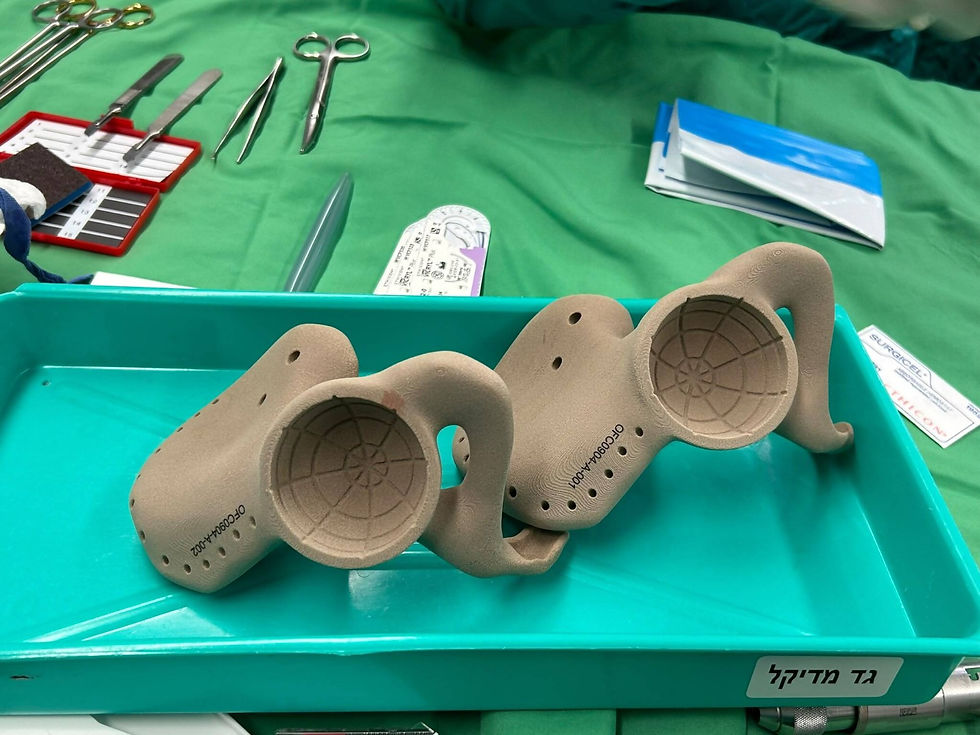
The 3D-printed artificial pelvis was implanted into Mark's body.
Hundreds of hours of preparation
The team of surgeons devoted hundreds of hours to precise digital planning of the procedure. Mark's anatomy was digitally modeled in order to design an implant that would precisely match the portion of the pelvis that needed to be removed.
The surgery ultimately lasted 19 hours.
"This was one of the most complex and challenging cases we have ever encountered," said Dr. Israel Weiss, head of orthopedic oncology at Schneider and Beilinson. "Rather than considering the tumor inoperable, our teams combined custom 3D design with advanced printing technologies to open up new possibilities."
The procedure also involved several specialists, including Dr. Eviatar Nesher, head of the transplantation department at Beilinson, and Professor Yona Kosashvili, head of the hospital's orthopedic department.
Rebuilding the pelvis while preserving mobility
Beyond removing the tumor, the surgeons faced a second major challenge: enabling Mark to regain as much mobility as possible. According to Dr. Arie Greenberg, a specialist in arthroplasty and orthopedic oncology at Beilinson, the implant was made from an advanced polymer designed to allow bone growth within its structure and was specifically adapted to the patient's unique anatomy.
Mark is currently recovering at Schneider Children's Medical Center, where he is undergoing rehabilitation under the supervision of his medical team, which is closely monitoring his progress. For the Israeli medical teams, the procedure primarily demonstrates the possibilities created by combining oncology, orthopedic surgery, biomedical engineering, digital modeling and 3D printing.
Caroline Haïat


Comments