

Israel develops AI-powered drone capable of detecting wildfires within minutes

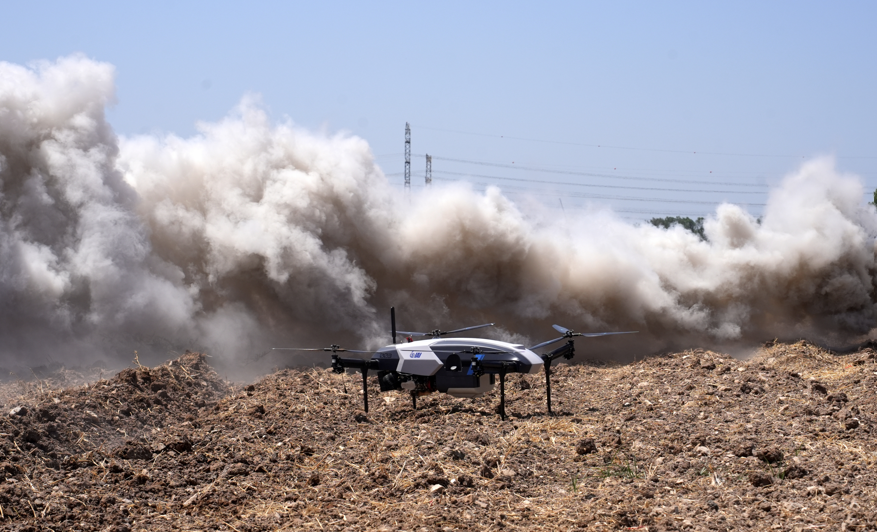
As climate change fuels increasingly frequent and destructive wildfires, Israel is taking a major technological step forward. A consortium bringing together the Ministry of National Security, the Israel Innovation Authority, Israel Aerospace Industries (IAI), the Technion, and Israel Fire and Rescue Services is developing an artificial intelligence-powered autonomous drone system capable of detecting wildfires just minutes after they ignite. The system recently completed its first successful flight test.
Wildfires have become one of the most visible consequences of global warming. Rising temperatures, prolonged droughts, and more frequent heatwaves have made fires more common, more intense, and increasingly difficult to contain. In this context, early detection has become a critical factor: the sooner a fire is identified, the greater the chances of preventing it from spreading.
This is precisely the challenge Israel aims to address through a new aerial surveillance system combining artificial intelligence, infrared sensors, and autonomous drones.
A drone designed to monitor vast areas
At the heart of the project is the APUS 25, a vertical take-off and landing (VTOL) tactical drone developed by Israel Aerospace Industries (IAI). Unlike most surveillance drones powered by batteries, the APUS 25 is equipped with an internal combustion engine, allowing it to remain airborne for several hours and conduct extended missions without interruption.
Capable of taking off from virtually any location without requiring a runway, the drone can monitor hundreds of square kilometers during a single flight. Once firefighters define the surveillance area on a digital map, the aircraft autonomously flies to its optimal observation point and continuously patrols the area for four to five hours.
The innovation extends well beyond the aircraft itself. Equipped with daylight and night-vision cameras as well as infrared sensors, the drone can detect thermal signatures even in complete darkness or through dense smoke.
The collected data is analyzed in real time using advanced spectral processing algorithms and artificial intelligence developed in collaboration with researchers from the Technion. The software automatically identifies anomalies, recognizes the earliest signs of fire, and calculates the precise location of a hotspot within just a few meters.
Once a wildfire is confirmed, an alert is immediately transmitted to the Israel Fire and Rescue Services command center. Emergency teams receive the exact location of the fire along with live imagery, enabling them to deploy the most appropriate resources without delay.

Reducing response time to limit damage
By detecting fires within minutes of ignition, the system could dramatically reduce the area burned, minimize risks to nearby communities, and better protect critical infrastructure and natural ecosystems.
For Yaron Schone, Director of the Technological Research and Development Department at Israel's Ministry of National Security, the project demonstrates how advanced technologies can address real operational challenges.
"The combination of drones, artificial intelligence, and advanced data-processing capabilities will improve situational awareness, enable earlier wildfire detection, and significantly reduce emergency response times," he said.
A partnership between industry, academia, and government
According to Moshe Levy, Executive Vice President and General Manager of IAI's Military Aircraft Group, the initiative highlights Israel's ability to adapt cutting-edge technologies originally developed for complex defense applications to civilian uses with a direct impact on public safety.
Kerem Nevo, Vice President of the Israel Innovation Authority, emphasized that the partnership provides an opportunity to test breakthrough technologies under real operational conditions, accelerating their transition from research to practical deployment.
Meanwhile, Professor Asaf Schuster, from the Henry and Marilyn Taub Faculty of Computer Science at the Technion, described the project as a concrete example of how academic research can be transformed into a practical solution capable of saving lives while reducing environmental damage.
If future trials confirm the project's promising results, the technology could become a valuable new tool in the fight against wildfires—not only in Israel, but also in countries around the world facing increasingly severe climate-related disasters.
Caroline Haïat



Comments