

Mikael Benitah, the artisan who carves Jewish values into wood
- Caroline Haïat

- Apr 5
- 4 min read

After a decade working in IT, Mikael Benitah was far from imagining that his life would completely change when he discovered, almost by chance, his love for wood. This French-Israeli, who has been living in Jerusalem for 17 years, is now recognized for his unique creations that combine design and Judaism, all carrying strong symbolic value. He became particularly known for works created in memory of soldiers who fell during the war. On October 7, Mikael realized that his calling had changed direction: he moved from an individual commitment to a true dedication to others. “I understood that God had gradually guided me toward a different path, one that allows me to bring my personal touch to history,” he says.
Born in Marseille, Mikael obtained his high school diploma in France and then spent a year studying at a religious school (yeshiva) in Israel before returning to France to study computer science for three years. Shortly afterward, he got married in Israel and made aliyah. Mikael held a very good position at the telecommunications company Annatel, where he advanced quickly, but he was not fully fulfilled. An ordinary event would then trigger an awakening in the young man — a call toward a world that truly resonated with him.

"There was a space on my balcony that I needed to fill. I then came across photos of tzimer-style chalets made with half logs and I launched myself into this project alone, without any knowledge of carpentry. I spent entire nights on YouTube watching tutorials and the realization was immediate: I fell in love with wood. This material literally fascinated me and I understood that I wanted to create without limits," recalls Mikael Benitah.
Mikael, a self-taught wood craftsman, met professionals in the trade who encouraged him to continue along this path, recognizing the young man’s immense talent. Mikael shared his work on social media and, given the success, left the IT field to dedicate himself entirely to wood. He built a small eight-square-meter workshop on his terrace and spends most of his time there imagining creations, each more ambitious than the last.
"My work is divided in two: I make pergolas and outdoor wooden constructions, but I also do craftsmanship with raw wood. And to be honest, that’s what drives me, that’s what touches my soul. I function a lot with waves and energies, I am a very spiritual person. God allowed me to find my passion and it is a real gift," explains Mikael.
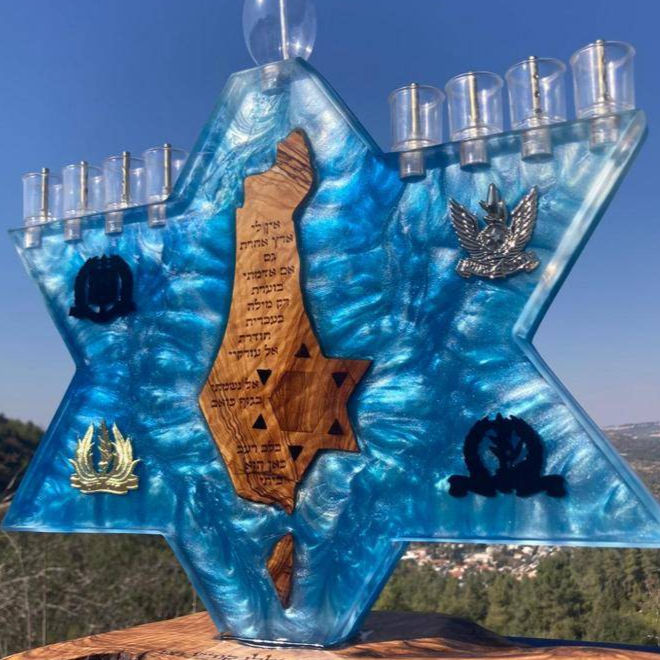
October 7, a major turning point
Like for most Israelis, the war of October 7 completely disrupted Mikael’s life. Not having been particularly Zionist before, this tragic event touched him deeply and became a kind of revelation: he had to act for the people.
Once again, he decided to mobilize his passion for wood in the service of the population. Since most shelters (mamads) did not close properly and therefore did not meet safety standards, Mikael decided to make wooden boards that fit directly into the handle and allow these rooms to be secured. He thus offered 4,000 of them to Israelis who needed them.
For nearly three years now, Mikael’s success has continued to grow. His secret? Combining wood — particularly oak, which he especially loves — with epoxy in order to create extraordinary pieces such as his famous Passover plate featuring the sea opening, recalling the story of the Hebrews saved from Egypt.

"The Passover plate I designed is conceived as a true visual narrative, both symbolic and deeply rooted in the history of the Jewish people. At the center, I wanted to represent the story of the Bnei Israel, following a chronological and fluid reading. On one side appear the pyramids of Egypt, evoking slavery and oppression. On the other side, regained freedom. Between the two, the sea opening and foam representing the power and the miracle of that moment. One can thus perceive the passage of the Hebrews through the sea, and then their arrival on dry land, cracked and frozen, marking both the end of the ordeal and the entry into a new reality," states Mikael.
The choice of a round plate is not insignificant. It symbolizes the cycle, a fundamental idea in the history of the Jewish people. For millennia, the same pattern seems to repeat itself: when the people move away, trials arise, embodied by enemies; then comes the time of awareness, of return — teshuva — and finally deliverance. This cyclical movement, present in our history for more than 3,000 years, is materialized here in the very shape of the object.
Judaism as a source of inspiration
The people of Israel, the land of Israel, and the divine: three key notions that appear in Mikael’s works and that give him the opportunity to convey his messages.
Driven by challenges and novelty, Mikael enjoys receiving special orders from his clients. Some of them have particularly challenged him on a professional, personal, and emotional level. He notably created works for women who lost their husbands or sons in the war.
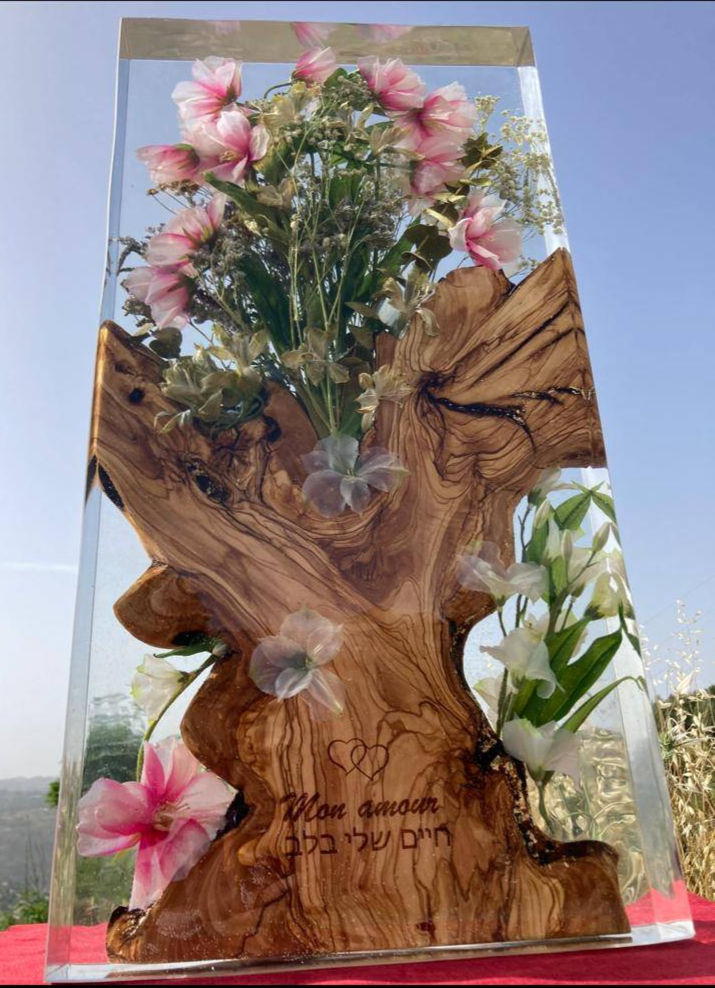
"One of them had received a bouquet of flowers from her husband at the front, and he died that very same day. This story moved me so much that I told myself that this bouquet had to be made eternal, since it represented the last gift from a husband to his wife. I dried the flowers and then incorporated them into the wood in order to preserve their memory. The symbolism is very powerful and for me, it is worth more than gold: making people happy," recounts Mikael.
Jewish holidays, notions of couple, children, nature, marriage — Mikael is waiting for only one thing: to be able to materialize all his ideas in wood while leaving a lasting mark at the crossroads of art, faith, and the history of the Jewish people.
More than a craftsman, Mikael embodies a generation that seeks to give meaning to its path and to transform its talents into commitment.
Instagram:https://www.instagram.com/mikawoodwork
Caroline Haïat

Comments