

One Year After the Missile Strike, Soroka Is Rebuilding the Future of Israeli Medicine
- Caroline Haïat

- Jun 17
- 3 min read

One Year After the Iranian Missile Strike, Soroka Medical Center Rebuilds Stronger, Safer, and More Advanced. One year after a direct Iranian ballistic missile struck Soroka Medical Center in Beersheva on June 19, 2025, the hospital is reflecting on a year marked by destruction, but above all by extraordinary mobilization, remarkable resilience, and an ambitious reconstruction effort. Today, Soroka is doing far more than repairing the damage. The medical center is transforming this ordeal into a historic opportunity to build a larger, safer, and more advanced hospital equipped to meet the healthcare challenges of the coming decades.
The Iranian attack targeted one of Israel’s most critical healthcare institutions. Soroka, the largest hospital in southern Israel, provides medical care to more than one million residents of the Negev. Beyond the extensive physical damage, the strike underscored the strategic importance of protecting essential civilian infrastructure against emerging security threats.
Medical Care Never Stopped Despite the Destruction
The missile caused severe damage to the Northern Surgical Hospitalization Building, the first structure built when Soroka opened its doors in 1959. The building housed inpatient wards, operating rooms, clinical and research laboratories, paramedical services, and various administrative facilities.
In the months that followed, extensive restoration work was carried out across the campus. Damaged infrastructure was repaired, windows, doors, and medical systems affected by the blast wave were replaced, and essential equipment was restored to ensure the continuity of healthcare services.
The Internal Medicine Building is now approaching full operational capacity following the complete renovation of three departments during the wartime period.
The Northern Operating Room Complex, which was completely destroyed in the strike, is currently undergoing a major reconstruction and reinforcement program. The surgical suites are being rebuilt according to the highest safety standards and are expected to reopen by the end of the year. At the same time, three new protected operating rooms are under construction elsewhere on campus to further expand the hospital’s surgical capacity.
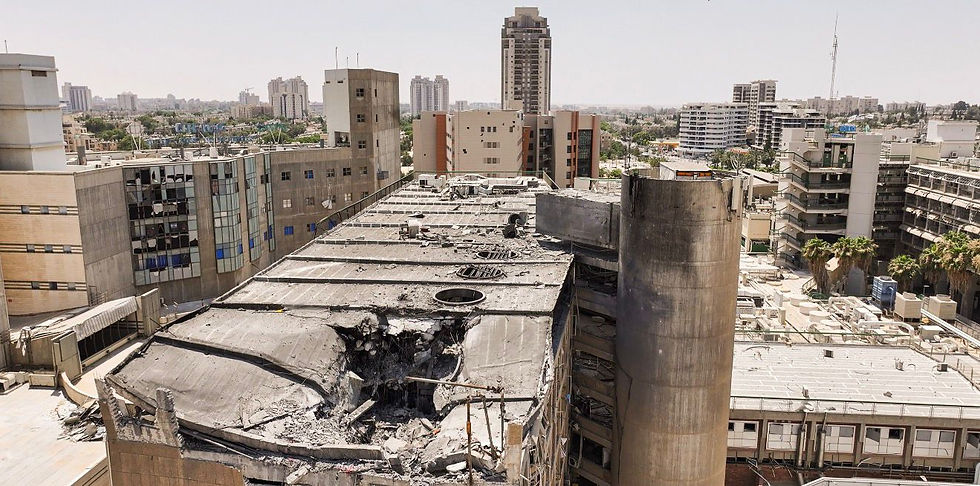
In March 2026, the eastern section of the Northern Surgical Hospitalization Building was safely demolished. Planning for the reconstruction of the western section has now been completed.
A Historic Transformation for Soroka
At the same time, Soroka and the Municipality of Beersheva are advancing an unprecedented expansion project that is expected to double the medical center’s built area and significantly transform healthcare services throughout southern Israel.
The large-scale development, spanning approximately 45 dunams west of the campus along Rager Boulevard, will include three multifunctional towers, nearly 300 residential units for healthcare professionals, hotel facilities, new medical institutes, outpatient care centers, commercial and professional spaces, and expanded parking infrastructure.
A new 11-story protected hospitalization building is also planned. It will house modern inpatient departments, a comprehensive cardiac center, a neuroscience and brain center, operating rooms, catheterization laboratories, and an underground parking facility capable of being converted into an emergency hospital during times of crisis.
Soroka is currently undertaking one of the most significant development programs in its history.
Over the coming months, four major projects are scheduled to open: a new protected neonatal intensive care unit equipped with state-of-the-art technology, a new research building, a rehabilitation center for adults and children that will include Soroka’s first-ever pediatric rehabilitation department, and an expanded emergency and trauma center designed to meet the needs of the rapidly growing Negev population.
“One year after the attack, we are not simply restoring what was damaged,” said Professor Shlomi Codish, Director General of Soroka Medical Center.
“We are building the next generation of healthcare in Israel: a larger, safer, more innovative, and more resilient medical center. As a healthcare institution serving more than one million residents of the Negev and a strategic pillar of Israel’s national resilience, Soroka demonstrates that an unprecedented crisis can become an opportunity for growth, innovation, and leadership.”
Professor Codish emphasized that this exceptional reconstruction effort has been made possible through close cooperation between the Israeli government, Clalit Health Services, and Israeli and international donors, including Sylvan Adams and the Koum Foundation.
One year after the Iranian missile strike, Soroka has emerged as a powerful symbol of resilience, innovation, and determination.
Caroline Haïat



Comments